Kampala.
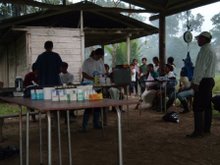
The past couple of days have been action packed, thankfully with lots of headway being made here in Uganda. As some of you may know, Kampala has recently experienced a slew of riots due to an unbearable rise on taxes on gasoline. The Walk to Work campaign, championed by political figure Bisgeye, has incited a lot of disruptive fighting on the streets. Friday was particularly bad, as Bisgeye was violently attacked by police chiefs on Thursday.
As far as our work was concerned, after Friday's excitement, things cooled down quickly. By Friday evening some shops had opened again and we even set out looking for our generator. Today (Saturday) was an extremely productive, long, sweaty day, full of bargaining, starting at 7am and ending 15 hours later discussing prices in the dark! The good news: we got almost everything (and everything major) on our list. Incredibly good news!
Tomorrow, we'll visit all our vendors, pay for our wares, and make some last price comparisons. We hope to be en route to Juba in our 20 ton truck by Monday, God willing. Riots are expected to pick up again then, making it impossible to do anything. We are grateful to be safe and sound and on schedule. We are also very grateful for the help of Mayen, a UU alum who just arrived in Juba with the medications we purchased in Nairobi.
Tuesday, May 17, 2011

The Malek Diaries - 4/27/2011
Nairobi.
Yesterday, we started the morning off by going to MEDS (Mission for Essential Medications and Supplies). Their office is a little fast from Ngong Road, where we are based here in Nairobi, but we used the missionary car to get there early so we could confirm our order. Our list of items is long, and we wanted to make sure we got everything!
When we got there we realized it was going to take longer than expected. Inexplicably despite three months of correspondence as well as having prepaid for our meds, the folks at MEDS were not expecting us! Over the next few hours we counted and recounted meds, made sure we had everything on our list, got some extra ranitidine and omeprazole for good measure (it seems like everyone had gastritis or ulcers, Kenyan as well as Sudanese!) and packed and labeled the boxes to our satisfaction. The delay notwithstanding, the people at MEDS were kind, good natured and helpful and we got it all sorted out.
We set off from the office in a matatu to go to lunch before visiting a local kenyan bank to open an account. Back when UU was working only in Kenya, we had little need for trans East African country banking. Now that we are in Uganda and Sudan, we need a bank account with a presence in all those countries. KCB fit the bill, so we took our business there.
Meanwhile, we finally got in contact with Garang. We were eager to speak to him after receiving his cost analysis to see whether traveling to Uganda for our purchases was a wise idea. His recommendation was to make the trip to Kampala since prices and availability were more assured there. He also told us some sobering news: his uncle was killed two days ago by a Murlee. His communication was delayed because he was attending the funeral. Our prayers are with his family.
On the bus ride home I saw two gentlemen dying on the street. Initially I was ready to yell to let me off the bus to do something to help, but I realized quickly how powerless I am, in so many ways. It also made me realize how much Kenyans themselves struggle to piece together a living. Over 50% of them are unemployed. This in arguably the most stable country in the region. How can we excite Kenyan med students and health professionals to work at our clinic when they themselves need a hand up? It's not the bleeding heart, champion of the poor mentality we have in our developed countries. Those ideals are a luxury here.
Over breakfast at Mayfield, I met a sweet Caucasian girl who I assumed to be American. It turned out she was born in Kenya, has lived here all her life, and is actually a junior in high school at a very well established school for missionary children in Kijabe, a small town with a prominent hospital staffed year round by foreigners. I wish our clinic can end up like that. Kijabe Hospital and Rift Valley Academy are deeply entrenched in the missionary community and culture, which keep it funded and running. In fact, I was surprised to read that Theodore Roosevelt himself commissioned the building of the academy back in 1906!
But UU work is not missionary work. Our work is health and education: sound minds and sound bodies. While we don't subscribe to the missionary culture, one thing we would do well to adopt from them is the idea of really getting to know the community before proposing a change, even if we think we know better than they do about things like disease and hygiene. We need to observe and listen first instead of talk first. That requires humility and patience in just the right dose.
Deng arrived safely last night with his wife and is staying at Mayfield as well. Today, the plan is to make our travel arrangements to Uganda. Mayen will be going straight to Sudan with the 90 kg of medicines and supplies. In Uganda, Deng, Mario, Mom and myself will make all our purchases and hopefully make it to Sudan early next week, where we will finally meet up with Garang and Kuai, two other vital members of Team UU.
Yesterday, we started the morning off by going to MEDS (Mission for Essential Medications and Supplies). Their office is a little fast from Ngong Road, where we are based here in Nairobi, but we used the missionary car to get there early so we could confirm our order. Our list of items is long, and we wanted to make sure we got everything!
When we got there we realized it was going to take longer than expected. Inexplicably despite three months of correspondence as well as having prepaid for our meds, the folks at MEDS were not expecting us! Over the next few hours we counted and recounted meds, made sure we had everything on our list, got some extra ranitidine and omeprazole for good measure (it seems like everyone had gastritis or ulcers, Kenyan as well as Sudanese!) and packed and labeled the boxes to our satisfaction. The delay notwithstanding, the people at MEDS were kind, good natured and helpful and we got it all sorted out.
We set off from the office in a matatu to go to lunch before visiting a local kenyan bank to open an account. Back when UU was working only in Kenya, we had little need for trans East African country banking. Now that we are in Uganda and Sudan, we need a bank account with a presence in all those countries. KCB fit the bill, so we took our business there.
Meanwhile, we finally got in contact with Garang. We were eager to speak to him after receiving his cost analysis to see whether traveling to Uganda for our purchases was a wise idea. His recommendation was to make the trip to Kampala since prices and availability were more assured there. He also told us some sobering news: his uncle was killed two days ago by a Murlee. His communication was delayed because he was attending the funeral. Our prayers are with his family.
On the bus ride home I saw two gentlemen dying on the street. Initially I was ready to yell to let me off the bus to do something to help, but I realized quickly how powerless I am, in so many ways. It also made me realize how much Kenyans themselves struggle to piece together a living. Over 50% of them are unemployed. This in arguably the most stable country in the region. How can we excite Kenyan med students and health professionals to work at our clinic when they themselves need a hand up? It's not the bleeding heart, champion of the poor mentality we have in our developed countries. Those ideals are a luxury here.
Over breakfast at Mayfield, I met a sweet Caucasian girl who I assumed to be American. It turned out she was born in Kenya, has lived here all her life, and is actually a junior in high school at a very well established school for missionary children in Kijabe, a small town with a prominent hospital staffed year round by foreigners. I wish our clinic can end up like that. Kijabe Hospital and Rift Valley Academy are deeply entrenched in the missionary community and culture, which keep it funded and running. In fact, I was surprised to read that Theodore Roosevelt himself commissioned the building of the academy back in 1906!
But UU work is not missionary work. Our work is health and education: sound minds and sound bodies. While we don't subscribe to the missionary culture, one thing we would do well to adopt from them is the idea of really getting to know the community before proposing a change, even if we think we know better than they do about things like disease and hygiene. We need to observe and listen first instead of talk first. That requires humility and patience in just the right dose.
Deng arrived safely last night with his wife and is staying at Mayfield as well. Today, the plan is to make our travel arrangements to Uganda. Mayen will be going straight to Sudan with the 90 kg of medicines and supplies. In Uganda, Deng, Mario, Mom and myself will make all our purchases and hopefully make it to Sudan early next week, where we will finally meet up with Garang and Kuai, two other vital members of Team UU.
The Malek Diaries - 4/26/2011
Nairobi.
We arrived in Nairobi two nights ago and have been making progress on our plans to buy the medical supplies and materials needed to finish the clinic building. Yesterday, we met with many of our students to follow up with their issues, including school fees, paperwork and any medical illnesses. We met with Nhial and Jool, high school students (Nhial just graduated!), and Deng and Thion, both medical students. Deng is in his 3rd year, Thion in his 2nd. We also met with John Alier, who has a diploma in pharmacy and will be going to Sudan with us. We also met with the rest of our team, including Mario Bol, a Lost Boy from San Jose, CA, and Mayen, a Universal Unity graduate who has been invaluable in our education project in Kenya. Deng, who many of you remember from our fundraiser event, will be arriving tonight.
Today, we are going to MEDS, a warehouse for nonprofits that sells reliable medications at low cost. We will pick up the medications we ordered for the clinic there. We will also have a meeting to decide, within the next two days, whether we will purchase the generator, windows, plaster, doors and other materials to finish the clinic building from Kampala (Uganda) or Juba (Sudan). We have done an extensive cost analysis with the help of Garang, another Lost Boy currently in Juba, but we want to make sure we get the best value as well as the best materials for the clinic, so it's an important decision!
From the medical/clinical side, we have also got a hold of a malaria net distribution evaluation questionnaire to evaluate the 500 nets passed out during Deng's and Jordan's trip last year. Evaluation is a crucial component of any public health intervention and one we are trying to be particularly mindful of as we move forward. We also have a contact knowledgeable in latrine interventions and are planning community meetings to discuss the logistics and community readiness for a dry bathroom vs. pit latrine project. Communication is everything!
We arrived in Nairobi two nights ago and have been making progress on our plans to buy the medical supplies and materials needed to finish the clinic building. Yesterday, we met with many of our students to follow up with their issues, including school fees, paperwork and any medical illnesses. We met with Nhial and Jool, high school students (Nhial just graduated!), and Deng and Thion, both medical students. Deng is in his 3rd year, Thion in his 2nd. We also met with John Alier, who has a diploma in pharmacy and will be going to Sudan with us. We also met with the rest of our team, including Mario Bol, a Lost Boy from San Jose, CA, and Mayen, a Universal Unity graduate who has been invaluable in our education project in Kenya. Deng, who many of you remember from our fundraiser event, will be arriving tonight.
Today, we are going to MEDS, a warehouse for nonprofits that sells reliable medications at low cost. We will pick up the medications we ordered for the clinic there. We will also have a meeting to decide, within the next two days, whether we will purchase the generator, windows, plaster, doors and other materials to finish the clinic building from Kampala (Uganda) or Juba (Sudan). We have done an extensive cost analysis with the help of Garang, another Lost Boy currently in Juba, but we want to make sure we get the best value as well as the best materials for the clinic, so it's an important decision!
From the medical/clinical side, we have also got a hold of a malaria net distribution evaluation questionnaire to evaluate the 500 nets passed out during Deng's and Jordan's trip last year. Evaluation is a crucial component of any public health intervention and one we are trying to be particularly mindful of as we move forward. We also have a contact knowledgeable in latrine interventions and are planning community meetings to discuss the logistics and community readiness for a dry bathroom vs. pit latrine project. Communication is everything!
Tuesday, February 1, 2011
Dr. Cynicism

I'm on my last heavy-duty rotation of medical school, spending four weeks in a surgical ICU in Southern California. It's hard to believe that four years has passed. I know that I've changed throughout medical school, but I can't cleanly delineate how, or whether it's a positive change.
I remember worrying about changing in the beginning of medical school. I didn't want to become cut and dry, lacking in human spirit. I know so many physicians who treat their work like it's a day job, and that's not why I worked so hard to get into this field. I was reaching for something larger than life, some sort of zen or nirvana or self-actualization that I believed could only be achieved by dedicating my life to healing others. To doctors, I know now that this reasoning sounds insufferably common. To me, it just sounded true.
As part of my training in the SICU, one of our professors suggested we read a recent article in the New Yorker on death and dying, and the trillions of dollars spent on heroic measures at the end of one's life. I see this firsthand every day on our unit: for instance, there's the 60-year-old man with terminal lung cancer, sedated and paralyzed, on a ventilator forcing a measured volume of air with a measured content of oxygen at a measured volume of pressure through his chest to keep him alive because he can't breathe on his own. He and his family wanted us to do everything possible to keep him alive. Last week, the surgeons decided to put a permanent breathing tube in his throat to make him more comfortable. He came out of the procedure retching and nauseous, inexplicably more uncomfortable now than before. He died the next evening.
Dr. Gawande's article spells it out nicely, with similar heart-wrenching stories of people choosing the illusion of an ugly life over the inevitability of a "more" peaceful death. Interestingly, however, Gawande hints that the onus is at least in part on health care professionals to manage patients' expectations. After all, they are not as equipped as we are to make treatment decisions. Then again, who are we to decide the course of their lives?
At the heart of this struggle is, as my professor declared, America's unwillingness to accept death as an inevitable outcome. I'm sure our nation's litigious tendencies, particularly fearsome in the field of medicine, don't help. Sounds pretty hopeless.
So as a fourth-year medical student entering a system plagued with staggering costs, wasteful practices, and complex social injustice, is there a role for optimism?
I have asked myself this question about optimism many times and no matter what situation prompts me to question my natural tendency towards it, I always come out with the same answer. Whether it's building a clinic in South Sudan, bringing eco stoves to the Chiapan mountains, being there for an ailing family member, or petting a lame dog, the answer is always the same: you must act.
But why? Why should you intubate the terminally ill cancer patient who has essentially no physiologic reserve, sedating and paralyzing him so you can have a machine breathe for him in his last days of living, robbing him from any hope of interaction with his wife and daughter? For the preservation of life? For the preservation of dignity, if you define dignity as honoring your patients' wishes in their darkest moments of dying?
And why should you spend $2,000 risking your life and future to travel to a war-torn village in Africa the world has no use for, to bring health care to a place struggling with far more basic provisions like peace and water?
For that matter, why tell anyone to quit smoking?
I am convinced, more than ever, at the risk of sounding egotistical, that the job of physicians is to bring hope to their patients. This is not an unbridled brand of hope, whereby an 80-year-old patient can take up salsa lessons after her bilateral hip arthroplasties. No. It is a measured hope, where the physician essentially counsels his patient, "This is what you can expect if you do this, and that is what you can expect if you do that, and I will help you understand what your decisions entail, how they will affect your life, and how you can get where you want to go." We give people choices by giving them knowledge. If you don't tell your diabetic patient what can happen if she doesn't control her blood sugars, how can you expect her to care? She didn't go to medical school. YOU did.
I'm sure the situation is not as simple as I'm laying it out here. It is far more complex. But at the heart of the matter is still the patient's best interests, and far too often, health care professionals forget this. As Dr. Gawande puts it, we often get swept up in their whims, making ourselves salespeople and our patients consumers. After all, this is America, and the customer is always right.
At the end of the day, it IS the patient that calls the shots. The gentleman who passed away last week had every right to demand mechanical ventilation in his last days. Or did he?
My dad always used to say that when you live in a society, whether you like it or not, you have to conform to certain societal laws. As taxpayers, whether we like it or not, we pay for certain civil services that we ourselves may or may not make use of. One of these services is government-issued health insurance for the destitute and the elderly.
In America, we are at odds. We buy into this sense of shared existence, but we also defy it by protecting our personal rights to all kinds of things. End-of-life care is the perfect example. We spend billions of dollars on one person's last week of existence, fighting the inevitable and throwing quality of life to the dogs. Meanwhile, somewhere else in the country, whole neighborhoods of children with potentially bright futures go unvaccinated, undernourished, underdoctored. Where's the justice?
When will things change? If history is our guide, only when they get so bad there's no choice but to make it better. Some would say, hasn't that already happened? Isn't medical spending sufficiently out of control to warrant acute efforts? Isn't health care access abhorrent enough? I'm not sure. What I do know is that the new crop of doctors entering the workforce should grow enough cynicism to be hungry for change, and enough idealism to fight for it. If the most salient thing we provide is hope, there is no place for apathy in this profession.
Thursday, November 11, 2010
You can't run, you can't hide
I'm on my second month of visiting rotations in surgical specialties, and while the experience has been mentally and physically demanding (as my family can tell you from all my complaining), it has also been tremendously rewarding. I truly love surgery, and just like most other milestones in life, what was initially a pipe dream is shaping into something more perfect than I could have ever anticipated.
I was always drawn to the surgical field, but it's only after several weeks of being on service that I'm starting to realize why I love it so much. Surgery, particularly vascular surgery, is intense. It's like a sport: you train for it, hone your skills, go out to battle, and continually analyze your performance to improve. Every doctor develops the practice of introspection to increase his competence. However, in surgery, it's not only knowledge but technical excellence. And the course of events for a patient changes so acutely with the surgeon's involvement that perfect action is even more crucial.
I'm on vascular surgery right now, and we've just had a couple of tough cases with major complications, including death. Each of these times, the patient had a potentially fatal, surgically curable disease (both, in fact, were AAA's). One of those patients is no longer alive (iliac vein injury), and the other does not have a duodenum (we cut through it). Both of these are major, predictable complications of AAA surgery. However, at the end of the day, they walked into the hospital well, and in our hands, suffered more than they were helped. The transaction is clear; we hurt those patients more than we helped them. Nowhere to hide.
One of those cases will certainly be discussed at Morbidity and Mortality conference next week. The chief resident will stand up in front of the entire surgery housestaff to go over the case with a fine-tooth comb and offer up our actions to critical minds. We will bear witness against ourselves and take responsibility for ourselves. This is what I love about surgery: nowhere to hide.
In surgery, you can't help but be honest. You can't help but be compulsive, hardworking, caring. If you see a little bleeding before you close the fascia, you don't wave it away assuming it will stop on its own. You go back and explore, you remove hard-earned sutures if you need to, because you know that bleed will declare itself as a hematoma later on if you don't. On an exploratory laparotomy, you run the bowel meticulously looking for injury, knowing that if you don't, the patient will develop colonic necrosis and decline rapidly. There's no way around doing your very best for the patient.
That's what I love.
I was always drawn to the surgical field, but it's only after several weeks of being on service that I'm starting to realize why I love it so much. Surgery, particularly vascular surgery, is intense. It's like a sport: you train for it, hone your skills, go out to battle, and continually analyze your performance to improve. Every doctor develops the practice of introspection to increase his competence. However, in surgery, it's not only knowledge but technical excellence. And the course of events for a patient changes so acutely with the surgeon's involvement that perfect action is even more crucial.
I'm on vascular surgery right now, and we've just had a couple of tough cases with major complications, including death. Each of these times, the patient had a potentially fatal, surgically curable disease (both, in fact, were AAA's). One of those patients is no longer alive (iliac vein injury), and the other does not have a duodenum (we cut through it). Both of these are major, predictable complications of AAA surgery. However, at the end of the day, they walked into the hospital well, and in our hands, suffered more than they were helped. The transaction is clear; we hurt those patients more than we helped them. Nowhere to hide.
One of those cases will certainly be discussed at Morbidity and Mortality conference next week. The chief resident will stand up in front of the entire surgery housestaff to go over the case with a fine-tooth comb and offer up our actions to critical minds. We will bear witness against ourselves and take responsibility for ourselves. This is what I love about surgery: nowhere to hide.
In surgery, you can't help but be honest. You can't help but be compulsive, hardworking, caring. If you see a little bleeding before you close the fascia, you don't wave it away assuming it will stop on its own. You go back and explore, you remove hard-earned sutures if you need to, because you know that bleed will declare itself as a hematoma later on if you don't. On an exploratory laparotomy, you run the bowel meticulously looking for injury, knowing that if you don't, the patient will develop colonic necrosis and decline rapidly. There's no way around doing your very best for the patient.
That's what I love.
Tuesday, June 15, 2010
Each year, the AMA has an essay contest on a burning question in ethics. There's a handsome prize for the winner: $5,000. I'm not really a fan of the field of ethics; while I recognize its usefulness in medicine, I don't enjoy arguing about heated topics with opinionated people when there's no right answer except the one you feel in your heart. But I have to admit, the prize money was a draw.
The topic was whether or not medical schools should use social networking sites like Facebook as criteria for making admission decisions on applicants. And while I didn't write the essay, I thought it was an interesting question because, at its core, it asks a deeper question about a physician's role in society.
As much as I used to roll my eyes at people who claimed this, I now understand why good medicine is not just another 9-5. We all want to believe we are special, putting ourselves out there for the world to appreciate. It's not a terrible thing; it's the human condition. If we don't believe we are special, what's the point of living?
But a good physician IS special. A good physician spends extra time with anxiously waiting family members to explain how the surgery went. A good physician translates the pathophysiology of disease processes into more digestible elements so his patients can participate in their own care. A good physician listens patiently to her patients' worries, even when they are unfounded. A good physician struggles to suppress judgment and objectively advise a patient whose health problems are clearly attributable to his own poor choices.
A good physician is someone who, after interacting with her, leaves you feeling better. It requires going above and beyond the call of duty. Doing the right thing, all the time, not because someone is looking over your shoulder, but because you are taking the responsibility of someone else's health in your hands.
This kind of person is not acting from 9-5. This kind of person just is.
What does this have to do with Facebook? I don't know the answer to the AMA's ethics question. I know many golden-hearted people who have what would likely be considered character-compromising material on their social networking pages. They are professional when they need to be, and unprofessional when they want to be. What's the problem?
My dilemma is a little different. I'm a nondrinker, so you won't find pictures of me on Facebook in various states of drunken revelry or undress. But as a medical student who, this time next year, will have an MD behind my name (God willing), I find myself wondering how I am going to be a good person and a good physician at the same time. Yes, one necessitates the other. But they also conflict.
My sister, unlike me, is in the family-making phase of her life. She just had a beautiful baby boy, a little brother to her other beautiful 20-month old child. My parents, who came to this country at my age for medical residency, worked harder than I can imagine and made their wealth by God's grace, are growing older. I play an important role in my family's life, and that role is only growing. Not in a duty-bound sort of way, but in a loving, part-of-the-fold way. We are a nuclear family and stick together, helping each other solve problems, be good, and do good for ourselves, each other and when possible, others. When I was growing up, my parents always emphasized my studies. My job in life, as I understood it, was to go to an Ivy League school, attain a graduate degree, and become a working professional making lots of money (not for the sake of greed, but for the sake of respect) and living an honest life.
Well, three out of four ain't bad.
I went to Cal, got my graduate degree (x 2, almost), and am, I pray, living an honest life. I don't care how much money I make but as a physician, it will most likely be a respectable amount. But even though I am still a student, there's one criterion my parents forgot to emphasize when I was growing up: I am a person first, and a student second. Yes, my studies will get me that contributing role in society. But I cannot respect myself unless I am a contributing member of my family.
And that is a tall order. As I develop my personality as a physician, I have taken pride in actively listening to patients, involving myself emotionally enough to go the extra mile for them, but not so much that I incapacitate myself to give good care. I want to be a resource, a giver, a source of hope for my patients, God willing. But what about my family?
A person has only so much to give. A good physician gives a lot to her patients and their families. But what about their own? Are a professional giver's priorities skewed? How is it ok to spend those extra ten minutes at the end of a long day with a patient's family rather than your own?
So it seems that I don't have the answer to my own moral dilemma, either. All I know is that I'm incredibly grateful for the opportunity to be a physician, but also that it is only one role I play in life. I can only pray that my role as a good family member will make my role as a physician more complete. That the two will be synergistic in some way, perhaps in the preservation of some sense of humanity that seems to be buried in weathered professionals. And weathered people.
And that I have the wisdom to leave it entirely up to God.
The topic was whether or not medical schools should use social networking sites like Facebook as criteria for making admission decisions on applicants. And while I didn't write the essay, I thought it was an interesting question because, at its core, it asks a deeper question about a physician's role in society.
As much as I used to roll my eyes at people who claimed this, I now understand why good medicine is not just another 9-5. We all want to believe we are special, putting ourselves out there for the world to appreciate. It's not a terrible thing; it's the human condition. If we don't believe we are special, what's the point of living?
But a good physician IS special. A good physician spends extra time with anxiously waiting family members to explain how the surgery went. A good physician translates the pathophysiology of disease processes into more digestible elements so his patients can participate in their own care. A good physician listens patiently to her patients' worries, even when they are unfounded. A good physician struggles to suppress judgment and objectively advise a patient whose health problems are clearly attributable to his own poor choices.
A good physician is someone who, after interacting with her, leaves you feeling better. It requires going above and beyond the call of duty. Doing the right thing, all the time, not because someone is looking over your shoulder, but because you are taking the responsibility of someone else's health in your hands.
This kind of person is not acting from 9-5. This kind of person just is.
What does this have to do with Facebook? I don't know the answer to the AMA's ethics question. I know many golden-hearted people who have what would likely be considered character-compromising material on their social networking pages. They are professional when they need to be, and unprofessional when they want to be. What's the problem?
My dilemma is a little different. I'm a nondrinker, so you won't find pictures of me on Facebook in various states of drunken revelry or undress. But as a medical student who, this time next year, will have an MD behind my name (God willing), I find myself wondering how I am going to be a good person and a good physician at the same time. Yes, one necessitates the other. But they also conflict.
My sister, unlike me, is in the family-making phase of her life. She just had a beautiful baby boy, a little brother to her other beautiful 20-month old child. My parents, who came to this country at my age for medical residency, worked harder than I can imagine and made their wealth by God's grace, are growing older. I play an important role in my family's life, and that role is only growing. Not in a duty-bound sort of way, but in a loving, part-of-the-fold way. We are a nuclear family and stick together, helping each other solve problems, be good, and do good for ourselves, each other and when possible, others. When I was growing up, my parents always emphasized my studies. My job in life, as I understood it, was to go to an Ivy League school, attain a graduate degree, and become a working professional making lots of money (not for the sake of greed, but for the sake of respect) and living an honest life.
Well, three out of four ain't bad.
I went to Cal, got my graduate degree (x 2, almost), and am, I pray, living an honest life. I don't care how much money I make but as a physician, it will most likely be a respectable amount. But even though I am still a student, there's one criterion my parents forgot to emphasize when I was growing up: I am a person first, and a student second. Yes, my studies will get me that contributing role in society. But I cannot respect myself unless I am a contributing member of my family.
And that is a tall order. As I develop my personality as a physician, I have taken pride in actively listening to patients, involving myself emotionally enough to go the extra mile for them, but not so much that I incapacitate myself to give good care. I want to be a resource, a giver, a source of hope for my patients, God willing. But what about my family?
A person has only so much to give. A good physician gives a lot to her patients and their families. But what about their own? Are a professional giver's priorities skewed? How is it ok to spend those extra ten minutes at the end of a long day with a patient's family rather than your own?
So it seems that I don't have the answer to my own moral dilemma, either. All I know is that I'm incredibly grateful for the opportunity to be a physician, but also that it is only one role I play in life. I can only pray that my role as a good family member will make my role as a physician more complete. That the two will be synergistic in some way, perhaps in the preservation of some sense of humanity that seems to be buried in weathered professionals. And weathered people.
And that I have the wisdom to leave it entirely up to God.
Thursday, June 10, 2010
Reflections on the psych ward

As I come up on the last few of days of my psych rotation I find myself already missing it. Tomorrow I will write my last soap note on a psychotic patient. My subjectives will go back to being dull and uninspired, recording bowel movement consistency and skin turgor rather than colorful quotes or behavioral quirks. My morning rounds will involve conversations about passing gas instead of the latest visual hallucination. That is not to say that the field of psychiatry is one big party--on the contrary, some of the most dramatic, challenging and emotionally charged moments of my third year occurred on thus rotation. But when you are dealing with human behavior as your disease, the neat line between black and white that other fields draw so meticulously to protect their scientific practice often blurs to a chaotic gray. I would argue that this happens in other fields, too; it is just that psychiatrists are necessarily more comfortable navigating the nebulous territory of raw humanity.
I never thought that I would leave this rotation filled with, of all things, hope. Nowhere in my life have I witnessed in such detail the utter unravelling of an otherwise functional human being. However, also nowhere else have I participated so intimately in the process of healing the mind, and, or so it often seemed, the soul. Of course, I would be as deluded as my first schizophrenic patient if I thought we fix people. We play a brief role in a tiny sliver of their lives; for a moment in the grand scheme of things we share our existence and the goal of finding truth and clarity. Then the patients go on their way, back to mobile homes, group homes, or, rarely, families. And we move on, too, to the next crisis. Our next learning experience.
Daisy was a middle aged, stocky woman with piercing blue eyes and heavy features. When I first met her, her face was locked in a resolute grimace. She was muttering to herself and could barely acknowledge my existence, let alone carry on a conversation. How am I supposed to report on this patient’s status if I can’t even communicate with her, I wondered. For the first few days of her stay, my daily report went something like this: “Daisy is a 52-year-old Caucasian female with a long history of chronic paranoid-type schizophrenia brought in by police after she was found running away from her parents’ home convinced there was a bomb on the porch. Collateral information was obtained from her parents who state that the patient was stable on her treatment regimen until she was found catatonic in her apartment after calling 911. No known significant events or stressors preceded this episode. Overnight, there were no acute events. The patient slept three hours, anxious about a bomb under her bed. This morning, she continues to mumble to herself, responding to internal stimuli. She exhibits thought blocking and paranoid ideation, unable to complete sentences and perseverating over a knife she believes was placed in her abdomen against her will. The patient endorses abdominal pain secondary to the knife and requests a pelvic ultrasound. Legal status: she is on a 14-day hold for grave disability. Overall, her thought processes, hallucinations and delusions have improved from admission but she still exhibits debilitating symptoms and would benefit from continued inpatient care at this time. Disposition planning: the patient will be discharged to her apartment where she lives alone. Her son, who previously lived with her, refuses to participate in her care after receiving a disturbing call from her in which she pleaded with him to release her from the hospital because "Hell's angels are raping me here." Her parents are elderly and unable to provide support at this time but are willing to call Daisy each day for phone support."
This same distant patient, whose personality was initially such an enigma to me, slowly emerged from her psychosis to reveal a sweet, pleasant woman with a bright smile who loved to go on walks and listen to music. In her second week on the ward, Daisy began to style her dirty blonde bob and wear her own clothes. She looked lovely. One day, she came up to me and tugged on her shirt. “You like it?” she asked, her words slightly slurring together. “My parents brought it for me. The color’s called rust. It looks good on me. It’s hard to find.” I looked at her, amazed. It was one of the first conversations we had had about anything other than the voices in her head, the bomb under her bed, or the comb in her belly. It was Daisy, unplugged. Or plugged, rather. Another afternoon, I found her swaying in front of the radio to a Frank Sinatra tune. “You like music?” I asked her. “Yeah”, she said, her eyes glued to the radio. “Sometimes, when I’m at home, I turn on some oldies but goodies, close the curtains and dance.” She leaned towards me, shrugged her shoulders and smiled like a child indulging in guilty pleasure. Again: meet Daisy.
Another patient of mine, Lenny, had his first manic episode ever while I was on the ward. Lenny was a 33-year-old stockbroker with no prior psychiatric history who recently lost his job and was experiencing severe psychosocial stress. He had four children under the age of 5 and one on the way, as evidenced by his wife’s very pregnant belly the night of his admission. He was deeply religious, and in the past few weeks had become convinced that there was a bloody battle between good and evil being fought, and that the end of the world was near. He was so convinced of this fact that he initially eloped from the emergency room, anxious an earthquake was about to occur marking what he called “the end of times.” The first few days on the ward, Lenny kept to himself. On the surface, he appeared normal; he smiled appropriately, followed the rules, and was never agitated. I would learn of his delusions from the nurses, from my daily conversations with his wife--only occasionally did he let his anxiety loose with me. When I asked him if he missed home, he politely inquired whether I was asking about his home in Orange County, or his home in heaven. He refused to do yoga because he suspected it was a form of pagan worship. Several days after admission, when he was coming out of his manic episode (an occurrence that automatically earned him the diagnosis of bipolar disorder), he told me that he initially refused to let the phlebotomists blood drawn from his right arm because he was afraid it would leave the “mark of Satan.” Over his ten days of inpatient care I was able to witness Lenny lose nothing short of body, mind, and soul, and then slowly collect the pieces of his shattered self. Each day, just as Daisy’s delightful personality awakened just a shade more, so did Lenny’s insight into his delusions about the devil. “I don’t know how things got so intense”, he told me one morning during rounds. “It seemed so real. I really thought the world was gonna end.” This was the same man that sat in front of a judge during his 52/50 hearing and swore beyond a shadow of doubt in front of his wife, family friends, physician and me that he was right about his apocalyptic predictions. Who, as his colleagues were doing their pagan yoga stretches, launched a self-imposed 20-minute run around the milieu as “penitence for my sins”. By discharge, Lenny was asking about therapy to help him deal with stressors in a more productive way. He acknowledged that he had been depressed for months, maybe even years. He planned to change careers as he was finally able to admit that he had never felt comfortable playing the stock market. His wife filed for short-term disability for him so he could fully recover and help with the new baby. He understood the importance of taking his antipsychotic medications. He was in it for the long haul. Broken, yes. But in a brave, strong way. The way that forces you to reach into your insides and see what they’re made of. And then decide what you want them to be made of. I had faith that was Lenny’s path when he walked out of our ward, carrying his few belongings in plastic bags, wife in tow, eager to get home to his children and reinhabit his world.
Not every patient has a happy ending. My last patient Gina was in isolation when I first met her. She was crouched on all fours in the corner of the room, picking at invisible objects on the ground in front of her. She would occasionally try to lift herself up, only to flop back onto the floor. This would prompt her nurse to enter the room, trying to coax her back onto the bed. “34509!” she would scream, or some other combination of numbers. She complained of thirst, biting her lips until they bled. We offered her water; she opted to mold her hand into a shaking fist and bring it up to her mouth as if it were a glass. This was delirium.
Delirium tremens (DT), more accurately. Gina had a long-standing history of polysubstance dependence. She was a binge drinker brought in by her father after he found her walking naked on a street near their home. It was unclear whether her psychiatric disorder was organic or substance-related; she had never been sober long enough to figure it out. We sent her immediately to the main hospital for alcohol detox; she needed IV fluids, soft restraints, and Librium. 24 hours later, she came back to us, sensorium clear, personality disorder in full swing. She yelled, cried, sneered, blamed, and pleaded. It was disturbing behavior, but nothing even remotely resembling her delirious state on admission. She was unapologetic for her condition. “Why am I in here? I’m confused 24/7,” she would sneer, as if to say that crawling around the floor on all fours was all in a day’s work for her. Classic borderline: past suicide attempts, difficulty forming or maintaining any relationships, splitting (people were either the best or the worst, and her judgment changed on a whim), deliberate manipulation. She alternately kicked you away and drew you in: “You think this is a joke? Do you enjoy seeing me like this? Leave me in peace!” and literally two seconds later, when you walked away to give her (and yourself) a break, “See? You always just walk away! You don’t even care about me!” Despite Gina’s nasty behavior once she came out of DT, I found myself rooting for her. She would show flashes of kindness interspersted with her outbursts of agitation, thanking me profusely for my help while the tears from her last tantrum were still rolling down her cheeks. Drawing me in.
Gina left the hospital in this state, as there is nothing a hospital can do for a personality disorder except manage acute episodes. But what is fascinating to me I s how different a person she was from the Gina who was admitted five days ago, licking the furniture and trying to climb the padded walls in solitary confinement. The power of the human mind over the body and soul is overwhelming. As the delirium melted away, the real Gina came back, demanding the right to live her life. I knew well that alcohol would probably get the best of her again, and that she might end up in our ward or somewhere similar soon enough. But the transformation was amazing to witness nonetheless.
The power of the human mind. During a manic episode, patients feel like there is nothing they can’t do. They are up for days, minds racing, deluded into thinking they can solve the world’s latest crisis. Depressed patients won’t leave the house, incapable of experiencing any pleasure. Addicts mold their whole lives around their next hit, letting families, friends, jobs and hobbies fall by the wayside. Schizophrenics are tormented by voices often taunting them, or commanding them to hurt themselves or others. I know this now not because I read it in a book, but because I’ve gotten to know people with these illnesses.
Some people say that psychiatry should be an optional rotation in med school. The field has a reputation for being laid-back, so much so that many students and physicians in other fields don’t treat it as a medical specialty. I was one of those people until my rotation. But I was wrong. If there is an organic disease out there with medications that work to ameliorate its symptoms, a physician must know about it. I’m grateful for what my patients taught me, and for those precious moments where we met minds in their time of crisis to come to a better place.
Subscribe to:
Posts (Atom)