Labor and delivery—what a ward. It’s the happiest and saddest place in the hospital. When things go right, a new person is welcomed into the world. When things go wrong, lives are devastated. Always, always, two healthy lives are at stake, hanging in the balance. Anything can happen to either at any moment. For the patient and her family, it’s one of the biggest days of their lives. For the physician, it’s another stressful, restless day or night.
I am not a mother. I do, however, have 27 years of personal experience with a mother’s love—my own. For 27 years, I have been on the receiving end of pure, undying, unconditional, unrequited, undeserved love—this is a mother’s love. I am awed, humbled, perplexed, overwhelmed by this love. If God’s love is more than a mother’s—and I know it is—my mind cannot even begin to fathom it. A topic for another time.
Flashback to a couple months ago. As a treat after two stress-filled weeks of labor and delivery, I treated myself to a pedicure to soothe my raw, blistered feet. The pedicurist, a friendly young woman with a heavy Vietnamese accent and perfect English, chatted me up. She asked me what I was reading, where I lived, where my family was from. I put my Case Files down and decided to have a human conversation for a change. I asked her where she lived, where she was from. She had arrived in Orange County just 9 months ago with her husband and two children, 4 and 5 years old. Why did she come, I wondered? She had a good job back in Vietnam, she told me. She was manager of a department of a prominent software company. I asked her why she didn’t apply for a similar job here? I did, she said. They’re not hiring people with no work experience. Apparently, her Vietnamese corporate experience didn’t count. So she went to beauty school and started doing pedicures and manicures full-time, 6 days a week. But again, I asked, if her family was doing so well in Vietnam, why did they give it all up to come here and start over? The education is better here, she said. I lost my opportunity, but my kids will find theirs here.
I wondered if her kids, who were probably now waiting for her to come home for dinner, could ever fully grasp what she had given up for them. Would they ever work hard enough at school to do justice to her sacrifice? To make her days full of scrubbing strangers’ calluses and painting flowers on their toes worth it? How could they possibly understand?
And what about me? Sure, my parents came to this country with residency positions already secured, ready to be molded into surgeons. They forged a new path purely for themselves, not for their parents or children. But sacrifices come in different packages that are no more and no less poignant for their differences. The force behind them is one and the same.
My mother always used to tell me that I could never love her the way she loves me. That it was virtually impossible for me to reciprocate her love. That I would only understand it when I had my own children. I hated hearing this, and always vowed that she was wrong. I couldn’t bear the thought of her being right, because the imbalance seemed so unfair. But after 27 years, I have come to realize that as much as it shames me to admit it, she’s right. A mother’s love is inexplicable, unmatched; deep and complex yet, at the same time, simple and naked.
I guess that’s one of the things that amazes me the most about labor and delivery. The raw humanity of hope, expectation, joy, love and pain are all mixed up together in those moments of laboring. There is the mother who in excruciating pain screams "voy a matar a mi bebe!"--(i'm going to kill my child!)--and is, minutes later, cooing happily at her newborn as we suture an angry perineal tear. The pregnant teenager who comes to the ER pathetic, crying and vomiting, and leaves days later, proud and strong, body language transformed by her ordeal. It's a mother's love: exquisitely simple and impenetrably deep, and bears testament to the incredible relationship between parent and child.
Wednesday, March 31, 2010

Brief musings on a weekend off
It’s a gorgeous sunny So Cal day today. The air is sweet and there’s a slight breeze. It’s perfect tennis weather, reminding me of the old summer days when I would wake up in the morning, swing my racket bag over my shoulder and mentally prepare myself for a day on the courts. It’s been years since my last official tennis match, but I still can’t step on a court without remembering the sweat, the nerves, the excitement, the churning stomach.
These days I get my kicks not with topsin, angles and deftly placed serves (or so I liked to think), but with battling disease. Now it’s a pager, a stethoscope and a scalpel (on a good OR day) replacing my racket. Now I fidget by popping my pager in and out of its holder on my hip rather than rearrange my strings between points. The smell of a fresh can of tennis balls is replaced by the odor of cauterized flesh. But the sweat, joy, devastation and nerves are all too familiar, and after years of being holed up with basic science textbooks, I revel in the nostalgia.
These days I get my kicks not with topsin, angles and deftly placed serves (or so I liked to think), but with battling disease. Now it’s a pager, a stethoscope and a scalpel (on a good OR day) replacing my racket. Now I fidget by popping my pager in and out of its holder on my hip rather than rearrange my strings between points. The smell of a fresh can of tennis balls is replaced by the odor of cauterized flesh. But the sweat, joy, devastation and nerves are all too familiar, and after years of being holed up with basic science textbooks, I revel in the nostalgia.
Wednesday, November 11, 2009
It happened one night (call)
It was the third day of night call at 1 am, and the ED was slow. Our team was killing time in the workroom, half hoping for a patient to give us something to do and half ready to quit waiting around and just go to sleep. I was tired of wasting time, incapable of studying or resting, but I wanted a patient both for the experience and to have something to show for myself at rounds with our attending the next morning.
An hour later, there was still no patient, so I decided to throw in the towel. I went to bed wearing my pager, expecting that the night was over. I climbed onto the top bunk in one of the call rooms and passed out. 45 minutes later, I was awoken by my bunkmate to let me know that my pager had been going off for 15 minutes. I slid off the bed clumsily and made my way back to the workroom.
To my relief, my intern had been waiting for me to go see our patient. The new charge was a 10 year old boy named Miguel with upper respiratory symptoms, severe autism and a known seizure disorder. He was presenting with fever, productive cough and two recent seizures. We went down to visit him in the ED. I was flustered and groggy, and had to work hard to muster up my usual excitement at meeting a new family.
When we got to the patient’s holding room, we found a sweet-looking child asleep with his mom at bedside. Mom was clearly worn, with unbrushed hair and circles under her eyes. She was leaning over her son's listless figure, hands propped on the bed frame protectively. A teenage girl wearing a college sweatshirt and Uggs was curled up in a chair on the other side of the room.
We introduced ourselves, took a complete history and did a basic physical exam complicated by the fact that Miguel was both fast asleep and also developmentally delayed. He was definitely congested, and the X-ray confirmed pneumonia. This was his second ER visit in 24 hours, and on the car ride home from the first trip, he had his second seizure of the day. His mom, Anita, was clearly drained but determined to help him get well. She spoke quietly, and her body language made her seem timid, but all that was misleading. She was the mother of a sick child.
Before leaving the ED to put in orders, we had to inquire about Miguel’s behavioral issues—is he violent? Does he bite or kick? Does he ever need to be restrained? No parent of a developmentally delayed child enjoys this line of questioning, but it's our job to anticipate special needs and challenges. At this point in the interview, his sister woke up, uncurled herself in her chair and addressed us for the first time. "You know, he does bite sometimes, but it’s actually just his way of giving a kiss. He doesn’t even know he’s doing it and it doesn’t hurt at all.” She insisted that there was nothing to worry about. I was moved by her protective instinct for her little brother, and remember thinking how much she must love him to interpret a bite as a kiss from a child who’s likely incapable of showing affection. We left the family to put in orders for Miguel’s hospital stay. Satisfied that I'd finally gotten to see a patient, I went back to my bunk to catch an hour of sleep before morning rounds.
On night call, you don’t follow the patients you admit, so a couple of days passed before I went back to visit Anita and Miguel. As I walked in the room, I saw Anita struggling to hold her son up as he tried to stumble across the hospital room floor, dragging his IV pole with him. She looked up at me, tangled up in his limbs and wires, and laughed nervously. “He feels better so he wants to move around. He doesn’t understand that he’ll fall.” Together, we carried him to a chair. He had a blank expression on his face, the only look I’d ever seen from him. I spent some time chatting with Anita and tried to answer her questions. I left mother and son on the couch together, feeling overwhelmed by her love for him. It was the same way I felt that night in the ED with Miguel’s sister.
The next morning, we visited the family as a team during rounds, piling into his room and surrounding his bed. It was discharge day for Miguel, so the mood was light. He was sitting up in his bed and moving his wiry body from side to side, looking off in the distance. Anita was at his side as always, patting his matted hair. She told us he was happy today, and her spirits seemed lifted too. Then she bent down to offer him her cheek, and to my utter surprise, he turned his head to her and kissed it.
I was happy to be wrong.
An hour later, there was still no patient, so I decided to throw in the towel. I went to bed wearing my pager, expecting that the night was over. I climbed onto the top bunk in one of the call rooms and passed out. 45 minutes later, I was awoken by my bunkmate to let me know that my pager had been going off for 15 minutes. I slid off the bed clumsily and made my way back to the workroom.
To my relief, my intern had been waiting for me to go see our patient. The new charge was a 10 year old boy named Miguel with upper respiratory symptoms, severe autism and a known seizure disorder. He was presenting with fever, productive cough and two recent seizures. We went down to visit him in the ED. I was flustered and groggy, and had to work hard to muster up my usual excitement at meeting a new family.
When we got to the patient’s holding room, we found a sweet-looking child asleep with his mom at bedside. Mom was clearly worn, with unbrushed hair and circles under her eyes. She was leaning over her son's listless figure, hands propped on the bed frame protectively. A teenage girl wearing a college sweatshirt and Uggs was curled up in a chair on the other side of the room.
We introduced ourselves, took a complete history and did a basic physical exam complicated by the fact that Miguel was both fast asleep and also developmentally delayed. He was definitely congested, and the X-ray confirmed pneumonia. This was his second ER visit in 24 hours, and on the car ride home from the first trip, he had his second seizure of the day. His mom, Anita, was clearly drained but determined to help him get well. She spoke quietly, and her body language made her seem timid, but all that was misleading. She was the mother of a sick child.
Before leaving the ED to put in orders, we had to inquire about Miguel’s behavioral issues—is he violent? Does he bite or kick? Does he ever need to be restrained? No parent of a developmentally delayed child enjoys this line of questioning, but it's our job to anticipate special needs and challenges. At this point in the interview, his sister woke up, uncurled herself in her chair and addressed us for the first time. "You know, he does bite sometimes, but it’s actually just his way of giving a kiss. He doesn’t even know he’s doing it and it doesn’t hurt at all.” She insisted that there was nothing to worry about. I was moved by her protective instinct for her little brother, and remember thinking how much she must love him to interpret a bite as a kiss from a child who’s likely incapable of showing affection. We left the family to put in orders for Miguel’s hospital stay. Satisfied that I'd finally gotten to see a patient, I went back to my bunk to catch an hour of sleep before morning rounds.
On night call, you don’t follow the patients you admit, so a couple of days passed before I went back to visit Anita and Miguel. As I walked in the room, I saw Anita struggling to hold her son up as he tried to stumble across the hospital room floor, dragging his IV pole with him. She looked up at me, tangled up in his limbs and wires, and laughed nervously. “He feels better so he wants to move around. He doesn’t understand that he’ll fall.” Together, we carried him to a chair. He had a blank expression on his face, the only look I’d ever seen from him. I spent some time chatting with Anita and tried to answer her questions. I left mother and son on the couch together, feeling overwhelmed by her love for him. It was the same way I felt that night in the ED with Miguel’s sister.
The next morning, we visited the family as a team during rounds, piling into his room and surrounding his bed. It was discharge day for Miguel, so the mood was light. He was sitting up in his bed and moving his wiry body from side to side, looking off in the distance. Anita was at his side as always, patting his matted hair. She told us he was happy today, and her spirits seemed lifted too. Then she bent down to offer him her cheek, and to my utter surprise, he turned his head to her and kissed it.
I was happy to be wrong.
Sunday, September 13, 2009
Questions in the ER
The ER is, not surprisingly, a hectic place. When I'm evaluating a patient, it's often hard to have a conversation what with all the traffic and talking and monitors beeping, pagers going off, and phones ringing. It's also an undignified place-most people lying on the gurneys didn't plan to be there, so they didn't have the luxury of wearing something comfortable, bringing things they would need for the 8 or 9 hours they might be waiting, or calling someone who loves them to keep them company.
Most people who visit the ER are on the patient end of things. Here's how it is from the other side: our team, on call for the day, gets paged that we have a new admit. Most of the time, we're either sitting around in the team room waiting for this call, or we're in the middle of taking care of the last call. When we're free, we look the patient up in the computer to see if he/she's ever been to this hospital before. We build up our clinical suspicion based on previous record: if she was in for liver disease last time, we're going to bring drugs and alcohol up. If she's an asthmatic, we're going to ask about compliance with controller meds. If we have no prior history to go on, we look at the ER questionnaire to form a picture in our heads.
Once we've gleaned all we can, we go down to visit our new charge. We pepper them with rapid fire questions. Are you experiencing any chest pain, sir? Palpitations? Shortness of breath? How about nausea, vomiting, diarrhea, or constipation? Does it hurt when you pee? And how about when you poop? What did your mom die of? Your dad? Cancer in the family? Oh, I'm sorry. What kind? Where do you live? Where do you work? In the event that you were incapacitated and could not make decisions for yourself, who would you like to make medical decisions for you? Would you like to have chest compressions or a tube put down your throat to help you breathe if you suddenly stopped doing so on your own?
All this, and we met five minutes ago.
Then we move on to the physical exam: Can I unbutton your shirt? Roll up your pants? Take off your shoes and socks? Does this hurt? Can you feel that?
It is a whirlwind 20 minute conversation, after which we leave the patient as promptly as we arrived, go back to our computers to write the official admission note and put in our orders, and wait for the patient to get a bed on the floor. In the meantime, we think of questions we forgot to ask that will help us figure things out.
What all too often forgets to be asked:
How are you holding up? Do you understand the plan? What questions can I answer for you? Not do you have any questions, but what questions do you have. Did anyone tell you the results of your blood test/X-ray/MRI? You'd be surprised. And what do those results mean to you? From a 5-year-old kid in need of a tonsillectomy: you're going to cut my head off and take out my tonsils and then sew it back on. From a patient with pneumonia found to have a pleural effusion, or fluid in the lungs, on chest X-ray: this happened because i drank too much water.
At the end of the day, sure, it could be more elegant. But nothing about this process is elegant. When you are sick enough to show up to the ER, you are stripped to your very core. When you are on call for 18-30 hours, sometimes into the wee hours of the night, you are also stripped to your core. And for the most part, decorum aside, patients are simply glad to answer any question they think will help you solve what's happening to them.
We just need to remember to return the favor.
Most people who visit the ER are on the patient end of things. Here's how it is from the other side: our team, on call for the day, gets paged that we have a new admit. Most of the time, we're either sitting around in the team room waiting for this call, or we're in the middle of taking care of the last call. When we're free, we look the patient up in the computer to see if he/she's ever been to this hospital before. We build up our clinical suspicion based on previous record: if she was in for liver disease last time, we're going to bring drugs and alcohol up. If she's an asthmatic, we're going to ask about compliance with controller meds. If we have no prior history to go on, we look at the ER questionnaire to form a picture in our heads.
Once we've gleaned all we can, we go down to visit our new charge. We pepper them with rapid fire questions. Are you experiencing any chest pain, sir? Palpitations? Shortness of breath? How about nausea, vomiting, diarrhea, or constipation? Does it hurt when you pee? And how about when you poop? What did your mom die of? Your dad? Cancer in the family? Oh, I'm sorry. What kind? Where do you live? Where do you work? In the event that you were incapacitated and could not make decisions for yourself, who would you like to make medical decisions for you? Would you like to have chest compressions or a tube put down your throat to help you breathe if you suddenly stopped doing so on your own?
All this, and we met five minutes ago.
Then we move on to the physical exam: Can I unbutton your shirt? Roll up your pants? Take off your shoes and socks? Does this hurt? Can you feel that?
It is a whirlwind 20 minute conversation, after which we leave the patient as promptly as we arrived, go back to our computers to write the official admission note and put in our orders, and wait for the patient to get a bed on the floor. In the meantime, we think of questions we forgot to ask that will help us figure things out.
What all too often forgets to be asked:
How are you holding up? Do you understand the plan? What questions can I answer for you? Not do you have any questions, but what questions do you have. Did anyone tell you the results of your blood test/X-ray/MRI? You'd be surprised. And what do those results mean to you? From a 5-year-old kid in need of a tonsillectomy: you're going to cut my head off and take out my tonsils and then sew it back on. From a patient with pneumonia found to have a pleural effusion, or fluid in the lungs, on chest X-ray: this happened because i drank too much water.
At the end of the day, sure, it could be more elegant. But nothing about this process is elegant. When you are sick enough to show up to the ER, you are stripped to your very core. When you are on call for 18-30 hours, sometimes into the wee hours of the night, you are also stripped to your core. And for the most part, decorum aside, patients are simply glad to answer any question they think will help you solve what's happening to them.
We just need to remember to return the favor.
Saturday, May 30, 2009
Back in Nairobi
I just got back from Juba yesterday, so now I can blog in real time. This adventure is almost over and I'm really grateful for it. I am satisfied that we did the right thing by coming in with the Wharton team to do a careful assessment, asking some hard questions before jumping right in. Sure, you walk away wondering if this trip did any good, but you have to think long-term. It's not always just about feeling good.
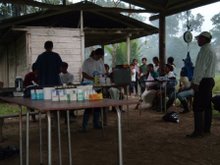
And what feels better than practicing medicine? Seeing patients, prescribing medicine after a 15-minute interview, and doing surgeries is very rewarding, from what little experience I have. In Malek, another thing we did was set up a makeshift clinic with the small pharmacy of drugs we brought with us. People came in droves with health problems of every kind. It was uncontrolled madness and we definitely could have organized ourselves and our patients better. My mom and I interviewed and examined the patients with the help of translators, and Orin, Grace and John filled "prescriptions". Sush went to distribute vitamins to the women, and was apparently nearly accused of poisoning them (one of the women told him to swallow a pill himself so they'd know he wasn't trying to kill them all).
It wasn't that we didn't do any good that afternoon. I think we did. We de-parasitized, killed fungal infections, cleaned abscesses, and treated diarrhea. We tried to give clear instructions on how to take the meds, although communication is the most overlooked, most important factor in doctor-patient interactions (and is 100 times harder when you're being ambushed by mothers pushing their kiddos toward you). I can only pray that we did some good. But I am more convinced than ever now that medicine is NOT the answer for rural health, at least not in Malek.
Those kids need clean water to drink, and they need protein. Their bellies are obviously swollen with kwashiorkor. What good will pylotrip do for their ulcers without a proper diet? They need latrines, and they need sewage. They need vaccinations. They need to go to school. They need better housing to shield them from the elements, of which there are many in East Africa, home to a billion bugs and all those cool safari animals.
When we got back to Juba from Bor, we had a debriefing where the Warton team gave my mom and I their impressions of where Universal Unity should go next. They were all against building a clinic, as am I. Not because it's not needed, but because so much more, and so much more basic things, are needed more desperately. And because as a growing organization in its beginning stages, we don't have the know-how, the funds, the time commitment, or the managerial skills to make this happen. We're talking about a location where CRS, a behemoth of an aid organization with 10-year commitments to its subjects, is pulling out. What makes UU's chances better?
I'm not saying we should pull out too. Not at all. I think we should partner with Michael Lear from Real Medicine Foundation and send nurses to his nursing program at Juba Teaching Hospital. We can also help revise the curriculum and bring doctors and nurses in to help train for short periods of time (which is what we have to offer, since no one has stepped up to move to Africa permanently). I think we should refine our "Educate Refugees" project, which needs a lot of help before we take on something new (I knew this before we left for Sudan, and meeting former students in Nairobi only confirms it). In short, I think we should build capacity. In a few years, our students will be engineers and agriculturalists. We just met two high school graduates, Natalina and Mercy, who are hanging around Juba after sitting for the KCSE -- they would be perfect candidates for nursing school. In time, UU will be able to complete our promise to our students that we would help them find their way in life through education. It will be a more complete promise than simply paying their fees, and it would help us do what we've wanted to do all along: help Southern Sudan.
I'm mentioning this on the side, but the current peace agreement between the ever-warring North and South Sudan ends in 2011, at which time there will be a referendum. Kwai thinks the North will never agree to let the South be free for good, and I don't see why they would. He seems to think 2011 will bring war, at which time "you will see Kwai in uniform". With peace this fragile, building a clinic now makes even less sense. Better build capacity in a place where there is none, waiting for 2011 and its aftermath while continuing to educate students in Nairobi and hopefully soon in Juba.
And what feels better than practicing medicine? Seeing patients, prescribing medicine after a 15-minute interview, and doing surgeries is very rewarding, from what little experience I have. In Malek, another thing we did was set up a makeshift clinic with the small pharmacy of drugs we brought with us. People came in droves with health problems of every kind. It was uncontrolled madness and we definitely could have organized ourselves and our patients better. My mom and I interviewed and examined the patients with the help of translators, and Orin, Grace and John filled "prescriptions". Sush went to distribute vitamins to the women, and was apparently nearly accused of poisoning them (one of the women told him to swallow a pill himself so they'd know he wasn't trying to kill them all).
It wasn't that we didn't do any good that afternoon. I think we did. We de-parasitized, killed fungal infections, cleaned abscesses, and treated diarrhea. We tried to give clear instructions on how to take the meds, although communication is the most overlooked, most important factor in doctor-patient interactions (and is 100 times harder when you're being ambushed by mothers pushing their kiddos toward you). I can only pray that we did some good. But I am more convinced than ever now that medicine is NOT the answer for rural health, at least not in Malek.
Those kids need clean water to drink, and they need protein. Their bellies are obviously swollen with kwashiorkor. What good will pylotrip do for their ulcers without a proper diet? They need latrines, and they need sewage. They need vaccinations. They need to go to school. They need better housing to shield them from the elements, of which there are many in East Africa, home to a billion bugs and all those cool safari animals.
When we got back to Juba from Bor, we had a debriefing where the Warton team gave my mom and I their impressions of where Universal Unity should go next. They were all against building a clinic, as am I. Not because it's not needed, but because so much more, and so much more basic things, are needed more desperately. And because as a growing organization in its beginning stages, we don't have the know-how, the funds, the time commitment, or the managerial skills to make this happen. We're talking about a location where CRS, a behemoth of an aid organization with 10-year commitments to its subjects, is pulling out. What makes UU's chances better?
I'm not saying we should pull out too. Not at all. I think we should partner with Michael Lear from Real Medicine Foundation and send nurses to his nursing program at Juba Teaching Hospital. We can also help revise the curriculum and bring doctors and nurses in to help train for short periods of time (which is what we have to offer, since no one has stepped up to move to Africa permanently). I think we should refine our "Educate Refugees" project, which needs a lot of help before we take on something new (I knew this before we left for Sudan, and meeting former students in Nairobi only confirms it). In short, I think we should build capacity. In a few years, our students will be engineers and agriculturalists. We just met two high school graduates, Natalina and Mercy, who are hanging around Juba after sitting for the KCSE -- they would be perfect candidates for nursing school. In time, UU will be able to complete our promise to our students that we would help them find their way in life through education. It will be a more complete promise than simply paying their fees, and it would help us do what we've wanted to do all along: help Southern Sudan.
I'm mentioning this on the side, but the current peace agreement between the ever-warring North and South Sudan ends in 2011, at which time there will be a referendum. Kwai thinks the North will never agree to let the South be free for good, and I don't see why they would. He seems to think 2011 will bring war, at which time "you will see Kwai in uniform". With peace this fragile, building a clinic now makes even less sense. Better build capacity in a place where there is none, waiting for 2011 and its aftermath while continuing to educate students in Nairobi and hopefully soon in Juba.
Tour of Bor and assessment in Malek
The next day was our only full day in Bor, so we had to make the most of it. We started by meeting IMA's team leader in Jonglei, Dr. Makina, and the state level minister of health, whose name I honestly don't recall. Dr. Makina is an MD/MPH, and the IMA (International Medical Agency) is the most important health care player in SS right now (the Government of SS, or GOSS as the cool kids call it, is broken and broke, and a multi-donor trust fund is the only money available for public services). It was a very informative meeting, and we got a lot of historical and
current information about Jonglei, Bor and Malek. The census data is shaky at best. But they were able to outline the biggest challenges they face, and where they think opportunities for aid might lie. It was a useful meeting.
Aware of our tight schedule, we first set out with Dr. Benjamin to tour Bor Town Hospital. The hospital is a converted barracks, staggering to meet the needs of its population. The buildings are dilapidated, and a few have been abandoned due to asbestos or massive bat invasions. There are makeshift buildings, such as the surgical ward, which is literally a tent donated by MSF. Inside, the heat and stuffiness are sweltering. I was shocked that either surgeon or patient could survive an operation under such conditions, but Dr. Benjamin said nothing. As in almost all other resource poor medical settings, they do almost all operations under spinal anesthesia.
Just as the conditions of Juba Hospital made me understand the dire need for health care in the capital city of SS, so did the conditions of Bor Town Hospital. But I was also struck by the distinct recognition that these people are doing the best they can with the resources available to them. There is no funding for salaries, yet they have four midwives. Their budget is hardly worth mentioning, yet they have an x-ray machine and an ultrasound. They do antenatal care. They have a lab where they run tests, and they treat patients based on the results. They do the best they can with what they've got.
After the hospital tour, we set off for Malek, a half hour drive from Bor Town. In Malek, we surveyed a couple of potential building sites. The team favorite was hands-down the site near the Nile with the open grass field, where Deng envisions planting crops to feed the patients of our proposed clinic. We then had to introduce ourselves to the village elders, which was a drawn-out affair of seeking to understand and to be understood. From our side, Orin did an excellent job of
being gracious and diplomatic. On their side, it was helpful (if not encouraging) to hear their reservations about our promises (and whether we would fulfill them, or disappear). It was also nice to know that they acknowledge our work educating their refugee relatives in Kenya.
current information about Jonglei, Bor and Malek. The census data is shaky at best. But they were able to outline the biggest challenges they face, and where they think opportunities for aid might lie. It was a useful meeting.
Aware of our tight schedule, we first set out with Dr. Benjamin to tour Bor Town Hospital. The hospital is a converted barracks, staggering to meet the needs of its population. The buildings are dilapidated, and a few have been abandoned due to asbestos or massive bat invasions. There are makeshift buildings, such as the surgical ward, which is literally a tent donated by MSF. Inside, the heat and stuffiness are sweltering. I was shocked that either surgeon or patient could survive an operation under such conditions, but Dr. Benjamin said nothing. As in almost all other resource poor medical settings, they do almost all operations under spinal anesthesia.
Just as the conditions of Juba Hospital made me understand the dire need for health care in the capital city of SS, so did the conditions of Bor Town Hospital. But I was also struck by the distinct recognition that these people are doing the best they can with the resources available to them. There is no funding for salaries, yet they have four midwives. Their budget is hardly worth mentioning, yet they have an x-ray machine and an ultrasound. They do antenatal care. They have a lab where they run tests, and they treat patients based on the results. They do the best they can with what they've got.
After the hospital tour, we set off for Malek, a half hour drive from Bor Town. In Malek, we surveyed a couple of potential building sites. The team favorite was hands-down the site near the Nile with the open grass field, where Deng envisions planting crops to feed the patients of our proposed clinic. We then had to introduce ourselves to the village elders, which was a drawn-out affair of seeking to understand and to be understood. From our side, Orin did an excellent job of
being gracious and diplomatic. On their side, it was helpful (if not encouraging) to hear their reservations about our promises (and whether we would fulfill them, or disappear). It was also nice to know that they acknowledge our work educating their refugee relatives in Kenya.
Finally on our way to Bor
After a few eventful days in Juba, we were ready to make the 200-km, 7 hour long trip to Bor Town on May 26. However, we were told that the police commissioner would not allow travel and that the roads would be blocked. Apparently, we had the good fortune of being in town for SPLA Day. While SPLA Day (SS Independence Day) actually falls on May 16, the celebrations are staggered across cities in SS to allow the president to be present for all the festivities. I thought it was strange that the capital of SS should have its SPLA Day ten days after the real thing, but whatever.
So on May 26, we pushed back our plans to travel and decided to celebrate the national holiday by going to the festivities. We saw some lively performances by men and women, singing and dancing in circles with colorful costumes and noisemakers of every kind. Older women sang about their days as female soldiers during the wars, and others marched and danced in rows, celebrating freedom. SPLA soldiers lined the field, their guns inexplicably pointed at the crowds. It was definitely a sight to see. Afterward, we got ourselves out of the blazing sun and ate lunch at a cute British sandwich shop (Juba is a place of utter social contradiction) where we saw some of the prime missionary/aid glitterati (Lebanese, American, Anglo, Japanese, Arab, you name it). Then, we drove home to Samaritan's Purse, rested until the sun let up, and went for a gorgeous hike in the mountains with Lori. Great way to spend a national holiday, Juba or not!
The next morning, we set out for Bor. We were traveling with police escort to ensure our safety, so we had to wait six extremely frustrating hours for our entire entourage to assemble itself. We had 21 armed soldiers with us. It was a bit ridiculous.
By nightfall, we were in Bor, which is more of a shanty than a town, despite being the capital of Jonglei State. We were taken to the Freedom Hotel, where Mach and many others had suggested we stay for our short trip (two days). My mom was horrified at the thought of sleeping in tents and found the communal bathrooms and showers equally horrendous, but with Sushant and I leaning heavily toward setting up camp as soon as possible, we decided to make Freedom our new base. It was a good decision, I think, and by the second night, we hardly noticed all the bugs in our tent!
So on May 26, we pushed back our plans to travel and decided to celebrate the national holiday by going to the festivities. We saw some lively performances by men and women, singing and dancing in circles with colorful costumes and noisemakers of every kind. Older women sang about their days as female soldiers during the wars, and others marched and danced in rows, celebrating freedom. SPLA soldiers lined the field, their guns inexplicably pointed at the crowds. It was definitely a sight to see. Afterward, we got ourselves out of the blazing sun and ate lunch at a cute British sandwich shop (Juba is a place of utter social contradiction) where we saw some of the prime missionary/aid glitterati (Lebanese, American, Anglo, Japanese, Arab, you name it). Then, we drove home to Samaritan's Purse, rested until the sun let up, and went for a gorgeous hike in the mountains with Lori. Great way to spend a national holiday, Juba or not!
The next morning, we set out for Bor. We were traveling with police escort to ensure our safety, so we had to wait six extremely frustrating hours for our entire entourage to assemble itself. We had 21 armed soldiers with us. It was a bit ridiculous.
By nightfall, we were in Bor, which is more of a shanty than a town, despite being the capital of Jonglei State. We were taken to the Freedom Hotel, where Mach and many others had suggested we stay for our short trip (two days). My mom was horrified at the thought of sleeping in tents and found the communal bathrooms and showers equally horrendous, but with Sushant and I leaning heavily toward setting up camp as soon as possible, we decided to make Freedom our new base. It was a good decision, I think, and by the second night, we hardly noticed all the bugs in our tent!
Subscribe to:
Posts (Atom)